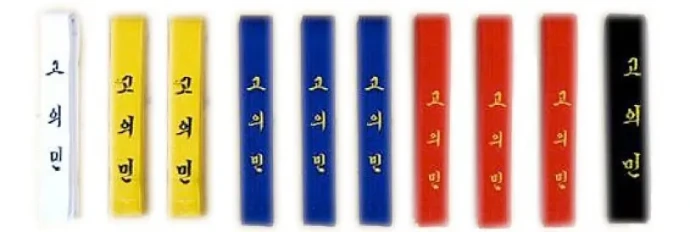
Why we preserve the five original colors of belts in Taekwondo
In modern Taekwondo, there are today a multitude of colorful intermediate belts. Although these progressive graduations serve as motivation in many systems, they often divert attention from the true heart of the discipline. In our school, we deliberately choose another path: we live a progressive Taekwondo, never forgetting its origins. That is why we preserve the traditional belt system, which focuses on the five fundamental original colors: white, yellow, blue, red, and black.
We owe this heritage to our Grand Master Ko Eui-min, to whom the highest distinction of 10th Dan was awarded posthumously. He was one of the most prominent figures in modern Taekwondo – a visionary who propelled this martial art onto the global stage. As the youngest national coach in Korean history, then president of the technical committee of the World Federation (WT) and technical delegate at the Olympic Games, he revolutionized Taekwondo through major innovations. It was Grand Master Ko who, in 1971, introduced the very first movement techniques (Stepp-Techniken) for free fighting (Gyeorugi), invented the first training target system (Coaching-Pratzen), patented electronic touch sensors, and greatly contributed to the evolution towards dynamics, speed, and tactical agility.
Yet, despite all his spirit of innovation, his patents, and the modernization of competitive sport, the philosophical depth and traditional education of the mind remained for Grand Master Ko the unshakeable foundation of this martial art. It is in this sense that we perpetuate his philosophy: we use modern and dynamic training methods while preserving the original belt system. Fewer colorful distractions means greater focus on the essentials: self-development and a deep understanding of traditional Korean philosophy.
The structure of the five colors of belts is based on the five elements of Korean cosmology (Ohaeng / 오행) as well as the cardinal directions and their corresponding symbols (Obangsaek / 오방색). They describe the cycle of nature and the maturation of the practitioner:
The White (하얀색 / Hayansaek) – The Origin
Cosmic element : Mu (무 / 無) – The Void / The Winter
Traditional description : The white symbolizes absolute purity, innocence, and a blank sheet of paper (Baekji / 백지). At this stage, the student has no knowledge (Muji / 무지) of the art of Taekwondo. In nature, this phase corresponds to winter – life rests invisible and deep under a layer of snow, but it holds the complete potential to be born at the right moment.
The Yellow (노란색 / Noransaek) – The Rooting
Cosmic element : To (토 / 土) – The Earth / The Center
Traditional description : The yellow represents the center, the unshakeable foundation, and the fertile nourishing earth. The seed of Taekwondo is sown and takes its first roots. The student learns the fundamental basic techniques (Gibon / 기본). In terms of the philosophy of nature, this is akin to the first and gentle light of early spring, which warms the earth and creates the necessary foundation of life for future growth.
The Blue (파란색 / Paransaek) – The Sky & The Growth
Cosmic element : Mok (목 / 木) – The Wood / The East
Traditional description : The blue represents the east, the spring sky, and the irresistible and powerful growth of a tree reaching towards infinity. Blue traditionally symbolizes the clear sky that charts the direction of growth. The student's techniques begin to take shape and develop vigorously. In Korean, this color is inseparable from the notion of youth and fresh, vital energy (Cheongchun / 청춘).
The Red (빨간색 / Palgansaek) – The Fire & The Danger
Cosmic element : Hwa (화 / 火) – The Fire / The South
Traditional description : The red represents the south, the element of fire, and the burning heat of mid-summer. Fire symbolizes the immense energy, dynamics, and striking power that the student now possesses. The fruits of hard work are ripe. At the same time, red acts as a strict alarm signal: anyone who masters the force of fire must learn, at this stage, to develop absolute spiritual self-control (Jajeryeok / 자제력) and a sense of responsibility, in order not to burn oneself or others.
The Black (검은색 / Geomeunsaek) – The Maturity & The True Beginning
Cosmic element : Su (수 / 水) – The Water / The North
Traditional description : Black is associated with the north and the unfathomable depth of the ocean. As black physically absorbs all other colors, this belt symbolizes maturity and the fusion of all the stages previously traversed. It represents overcoming fear and mastering fundamental principles.
However, with the attainment of the rank of Yudanja (black belt / holder of Dan), the path does not stop – this is where the greatest misunderstanding of modern times lies. The black belt marks the true beginning of Taekwondo. It is only now, as the physical tools and foundations are internalized, that the mind is ready for the true study of the way, the Do (way). The circle closes and simultaneously opens again: the master becoming a seeker who walks the path with the open and unbiased mind of a beginner.
Our Way on the Dojang
By cultivating this traditional philosophy, we create a space of clarity within our school. We combine modern and revolutionary training methods as well as sports progress, in the spirit of Grand Master Ko Eui-min, with the deep and authentic foundation of Korean tradition. Those who train with us do not chase after quick and colorful distinctions, but follow a clear path towards inner and outer mastery.